
Fly fishing is more than just a hobby—it’s a craft that rewards careful attention to small details. When you set up your fly reel, one of the most important steps is attaching backing. Many beginners focus on the fly line, but backing is the foundation that keeps everything secure and working smoothly. Without it, you risk running out of line if a big fish makes a long run. Even worse, you could damage your expensive reel or lose your catch. This guide will walk you through every step to attach backing to a fly reel, explain why it matters, and help you avoid common mistakes. Whether you’re new to fly fishing or want to improve your setup, this article will give you the confidence to do it right.
What Is Backing And Why Does It Matter?
Before you start, it helps to understand what backing is and why you need it. Backing is a strong, thin line—usually made from Dacron or gel-spun polyethylene—that you attach directly to your fly reel. On top of the backing, you wind your fly line. Backing serves two main purposes:
- Extra line for long runs: Some fish, especially larger species like salmon or bonefish, can swim much farther than your fly line’s length. Backing gives you extra line so you don’t run out during a fight.
- Filling your reel: Most fly reels are designed to work best when nearly full. Without backing, your fly line would not fill the reel completely, making it harder to retrieve and manage.
Beginners often miss a key point: not all reels or lines need the same amount of backing. Choosing the right amount and type is essential.
Tools And Materials Needed
Before you begin, gather these tools and materials:
- Fly reel (clean and ready)
- Fly line (do not attach yet)
- Backing (usually 20 or 30 lb test)
- Scissors or line snips
- Arbor knot instructions or reference
- Pencil (for holding the reel during winding)
- Reel seat or a helper (optional but useful)
- Pen and notepad (to record the amount of backing if needed)
Pro tip: Check your reel’s manual for recommendations on backing type and capacity. Using the wrong amount can lead to overfilling or underfilling, both of which create problems.
Choosing The Right Backing
Not all backing is the same. Let’s look at what you should consider:
| Backing Type | Strength (lb) | Diameter | Best For |
|---|---|---|---|
| Dacron | 20–30 | Standard | Freshwater, beginners |
| Gel-spun | 30–80+ | Thin | Saltwater, big fish |
- Dacron: The most common choice for most anglers. It’s affordable, reliable, and easy to handle.
- Gel-spun polyethylene: Thinner and stronger than Dacron, but more expensive and harder to knot. Used when you need extra line capacity.
Insider tip: For trout and most freshwater fishing, 20 lb Dacron is usually perfect. Use 30 lb only for larger species or if your reel’s manual recommends it.
How Much Backing Do You Need?
The right amount depends on your reel size and the type of fishing. Here’s how to figure it out:
- Check the reel’s specs: Most reels list the backing capacity on the box or spool (for example, “100 yards of 20 lb backing with WF5F line”).
- Consider your target fish: If you chase small trout, 50–100 yards is enough. For salmon or saltwater species, 150–300 yards may be necessary.
- Do a test fit if unsure: If you’re not sure, wind on the backing, then the fly line, and fill the reel almost to the rim (leave about 1/8 inch). If you overfill, remove some backing.
Beginner mistake: Overfilling causes tangles and jams. Underfilling gives a slow, awkward retrieve. Aim for the sweet spot—full but not packed.
Step-by-step: Attaching Backing To A Fly Reel
Let’s walk through the process from start to finish.
1. Prepare Your Work Area
Choose a clean, flat surface with good light. Lay out your tools and materials. If you have a reel seat, clamp your reel in it. If not, ask a friend to hold the rod steady or use your lap.
2. Attach The Backing To The Reel Spool
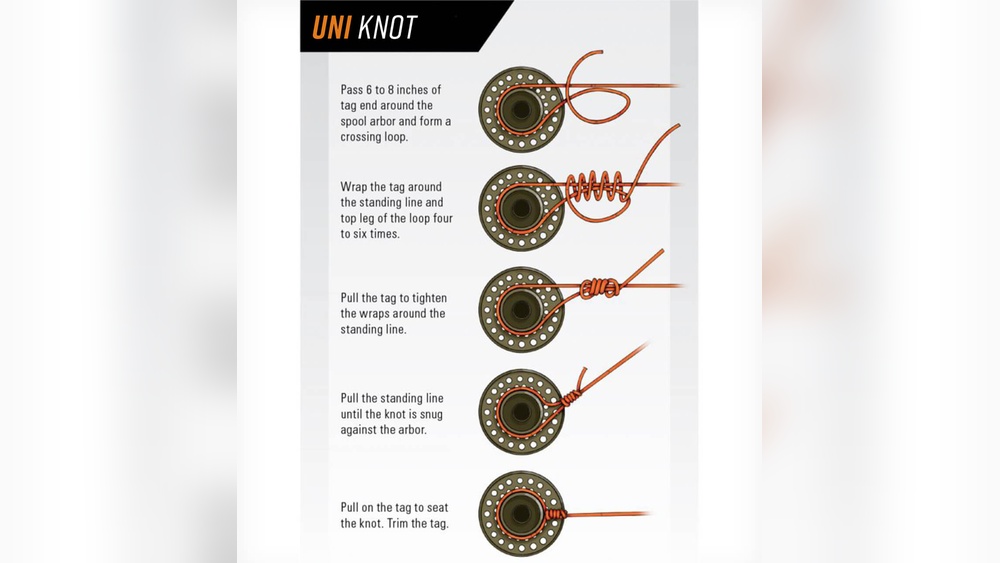
Most reels have an arbor—the center post where you start the backing. To attach the backing, use an arbor knot:
- Make a simple overhand knot at the end of your backing.
- Wrap the backing around the arbor (spool’s center).
- Tie another overhand knot around the standing line (the line going back to the spool).
- Slide both knots down to the arbor and pull tight.
The arbor knot is simple but strong. It keeps the backing from slipping on the spool, which is critical if a fish takes you deep into your backing.
3. Wind On The Backing
This step takes patience. Here’s how to do it right:
- Start turning the reel handle slowly, winding the backing onto the spool.
- Keep steady, even tension on the backing as you wind. Too loose, and it will dig into itself later; too tight, and you could damage the reel.
- Use a pencil through the backing spool or ask a friend to hold it so it spins freely.
- Guide the backing with your fingers so it lays evenly across the spool from side to side.
Pro tip: Wear a glove or wrap a cloth around your fingers to avoid burns or cuts if you’re winding a lot of backing.
4. Measure The Backing
If your reel’s specs say “100 yards,” you have two options:
- Pre-measured backing: Buy a spool that is already the right length.
- Estimate by sight: Wind until the spool is nearly full, then unwind and measure if you want to be exact.
- Use a line counter: For total accuracy, a line counter tool tells you exactly how much you’ve added.
Non-obvious insight: Most fly lines are about 90–100 feet (not yards), so don’t confuse feet with yards when planning.
5. Stop At The Right Spot
Leave enough space for your fly line. A good rule: stop winding backing when the spool is about two-thirds full. The fly line will fill the rest. Do not overfill.
6. Attach The Fly Line To The Backing
Now, connect your fly line. The best knot for this is the nail knot or loop-to-loop connection if your fly line has a welded loop:
- Nail knot: Strong and slim, it passes through rod guides easily.
- Loop-to-loop: Fast and easy, but only works if both backing and fly line have loops.
To tie a nail knot:
- Lay the end of the fly line and the backing side by side.
- Use a nail or small tube to help.
- Wrap the backing around the fly line and nail 5-7 times.
- Pass the backing back through the coils and tighten.
Beginner mistake: Don’t use a bulky knot here. Bulky knots catch on guides and make casting or landing fish harder.
7. Wind On The Fly Line
Once the backing and fly line are connected:
- Wind the fly line onto the reel, keeping light tension.
- Fill the spool until you have about 1/8 inch of space between the line and the rim.
Insider tip: Always wind the line in the same direction the reel turns during normal use. If you wind backward, the drag won’t work.
Key Knots For Attaching Backing
You will use at least two knots in this process. Let’s look at them in more detail.
Arbor Knot
The arbor knot is the standard for attaching backing to the reel. Here’s how to tie it:
- Pass the backing around the spool’s arbor.
- Tie an overhand knot in the tag end.
- Tie a second overhand knot around the standing line.
- Slide the knots tight against the arbor and pull.
Nail Knot
The nail knot is ideal for connecting backing to fly line. It is slim and strong.
- Place a nail or tube along the fly line.
- Lay the backing along the nail and wrap it 5–7 times.
- Pass the end of the backing through the wraps.
- Slide everything off the nail and tighten.
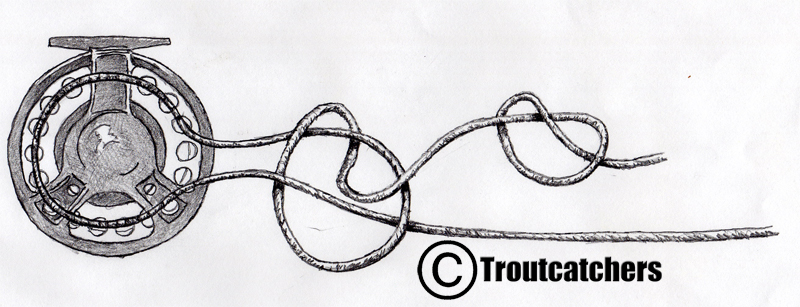
Loop-to-loop Connection
Some fly lines and backing come with pre-made loops.
- Pass the backing loop through the fly line loop.
- Pass the entire fly line spool through the backing loop.
- Pull tight.
This method is fast and easy, but not as slim as the nail knot.
Credit: www.troutcatchers.co.uk
Common Mistakes And How To Avoid Them
Even experienced anglers make errors. Here are mistakes to watch out for:
- Overfilling the reel: Too much backing causes jams and tangles. Always leave a gap at the rim.
- Underfilling the reel: Too little backing makes for slow line retrieve and poor casting.
- Loose backing: Backing should be wound tightly. Loose backing can cut into itself and jam.
- Wrong knot choice: Bulky knots get stuck in rod guides. Use slim, strong knots.
- Wrong backing type or size: Don’t use thick or weak material for big fish. Match the backing to your reel and target species.
- Winding in the wrong direction: Make sure you wind on backing and fly line in the same direction as the reel turns during use.
Insider tip: If you’re unsure, visit your local fly shop. Most will show you the correct method and may even wind it for you.
Practical Tips For A Professional Result
- Label your reel: Write the amount and type of backing on a piece of tape and stick it inside the reel foot.
- Check knots carefully: Pull each knot tight and test before adding the fly line.
- Clean your reel: Before starting, wipe the reel and spool to remove dust and grit.
- Use a line winder: If you plan to set up several reels, a line winder tool can make the job much easier and faster.
- Practice knots: Practice tying the arbor and nail knots before starting on your reel.
Credit: www.youtube.com
How Backing Choice Affects Performance
Choosing the right backing affects your fishing experience more than you might think.
| Backing Amount | Retrieve Speed | Risk of Running Out | Line Management |
|---|---|---|---|
| Too little | Slow | High | Loose line, tangles |
| Correct amount | Optimal | Low | Smooth operation |
| Too much | Can jam | Low | Frequent tangles |
Having the right amount of backing means you’ll have a faster, smoother retrieve, less risk of tangles, and a better chance of landing big fish.
Backing For Different Types Of Fishing
Not all fishing requires the same backing setup. Here’s what you need for the most common types.
Trout Fishing
- 20 lb Dacron
- 75–100 yards
- Most trout are not strong enough to pull all your fly line, but the backing fills the reel properly.
Salmon Or Steelhead
- 30 lb Dacron or gel-spun
- 150–200 yards
- These fish make long, fast runs. Stronger, longer backing is essential.
Saltwater Species (bonefish, Tarpon)
- 30–50 lb gel-spun
- 200–300 yards
- Saltwater fish are fast and powerful. Thin, strong backing increases capacity without overfilling.
Warmwater (bass, Pike)
- 20–30 lb Dacron
- 50–100 yards
- Most warmwater fish don’t require much backing, but it’s good insurance.
Key insight: Always match your backing to your target species and water type.
Storing And Maintaining Backing
Proper care of your backing ensures it lasts for years.
- Dry after use: If your reel gets wet, open it and let everything dry. Wet backing can rot or mold.
- Check knots regularly: At the start of each season, test all knots for strength.
- Replace old backing: Backing can last many years, but if it shows signs of wear or discoloration, replace it.
- Store reels properly: Keep reels in a cool, dry place. Avoid heat and sunlight, which can weaken backing.
Non-obvious tip: If you fish in saltwater, rinse the reel and backing with fresh water after each trip.
How To Remove And Replace Backing
Sometimes you need to remove old backing and start fresh. Here’s how:
- Remove the fly line: Wind it off the reel and set aside.
- Unwind old backing: Pull off the backing by hand or use a drill with a spool adapter.
- Clean the spool: Wipe the arbor and sides with a dry cloth.
- Inspect for corrosion: Saltwater can cause rust or corrosion. Fix any issues before adding new backing.
- Attach new backing: Follow the same steps as before: arbor knot, wind on tightly, measure, and connect your fly line.
Helpful tool: Some anglers use an empty plastic bottle on a drill to quickly remove old backing.
Backing And Reel Compatibility
Not all reels and backing work together perfectly. Some modern reels have large arbors (wide center spools), while older models have small arbors. Large arbor reels need less backing to fill the spool, but allow for faster line retrieval.
| Reel Type | Backing Needed | Main Advantage |
|---|---|---|
| Standard arbor | More backing | Traditional look, more line storage |
| Large arbor | Less backing | Faster retrieve, less line memory |
Pro tip: If you upgrade reels, always check the new reel’s backing capacity before setting it up.
When To Seek Professional Help
If you’re new to fly fishing, don’t be afraid to ask for help. Fly shops and experienced anglers are usually happy to assist. They can show you how to attach backing, recommend the right type, and even wind it for you.
Some shops use machines to wind backing under perfect tension, which is hard to do by hand.
If you lack tools, have a tricky setup, or just want peace of mind, a little expert help can save a lot of trouble later.

Credit: news.orvis.com
Advanced Tips For Experienced Anglers
If you want to take your setup to the next level:
- Use color-coded backing: Some brands offer backing with color changes every 50 yards. This helps you know how much line a fish has taken.
- Add a backing splice: For very large reels, splice two colors or types together to mark distances.
- Test your drag: With the backing and fly line in place, test your reel’s drag system to ensure smooth performance.
- Record your setup: Keep a fishing log with details of your reel, backing, knots, and fly line. This makes replacements and repairs easier.
Final insight: The best setups are not just strong—they are also neat, smooth, and matched to your fishing style.
Frequently Asked Questions
What Is The Purpose Of Backing On A Fly Reel?
Backing provides extra line beyond your fly line, letting you fight larger fish that run far. It also fills the reel, making it easier to retrieve line and use the drag system properly.
How Do I Know How Much Backing To Put On My Reel?
Check your reel’s specifications. Most reels list the recommended amount and strength of backing for each fly line size. When in doubt, fill the spool until there is about 1/8 inch of space left under the rim after the fly line is added.
Can I Use Regular Fishing Line As Backing?
It’s best not to. Monofilament is thicker and stretches more, so it won’t give you the same capacity or reliability as Dacron or gel-spun backing. Always use dedicated fly reel backing for best results.
How Often Should I Replace My Backing?
Check your backing every season. Replace it if you see fraying, discoloration, or mold. Most quality backing lasts many years if kept dry and clean.
What Knots Should I Use To Attach Backing?
Use an arbor knot to tie backing to the reel, and a nail knot (or loop-to-loop connection) to tie backing to your fly line. These knots are strong, slim, and reliable.
Fly fishing rewards those who pay attention to small details. Taking the time to attach backing properly can make the difference between landing a trophy fish and losing one. If you follow the steps above, use the right tools, and check your work, you’ll have a setup you can trust on the water. For more on fly fishing knots and gear, visit the Wikipedia fly fishing page for in-depth resources and illustrations.
Now, the next time you head to the river or lake, you’ll know your reel is ready for anything. Happy fishing!